
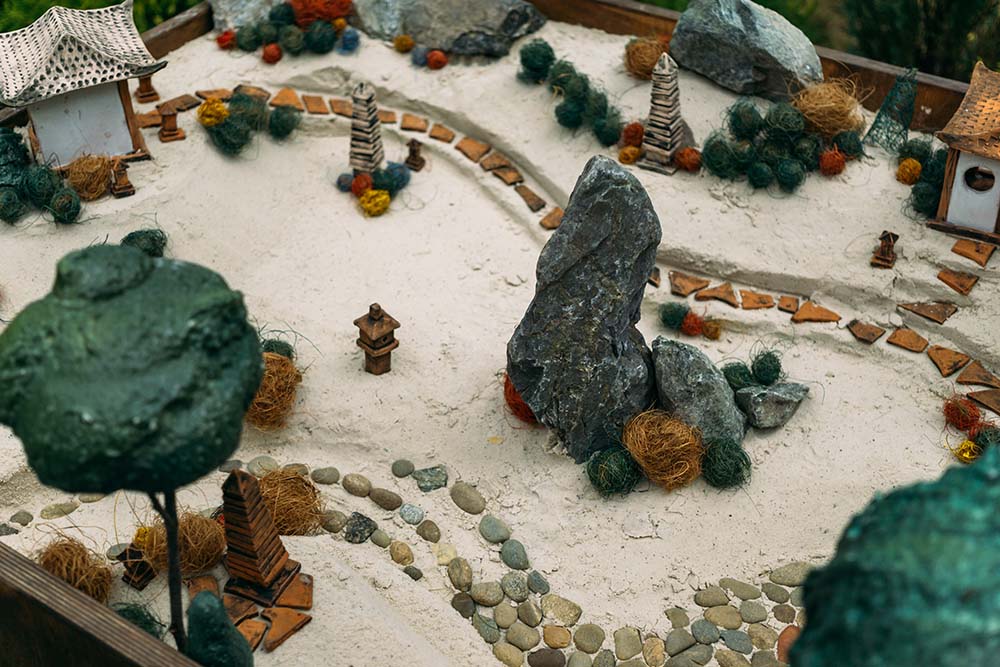
Sand tray therapy is a form of active imagination that can help us access and express material that may not be amenable to cognitive, verbal approaches. This type of therapy was developed in the 1950’s by Dora Kalff, a Jungian-oriented therapist, and is now used all over the world by people of all ages.
Picture a room with shelves full of objects, many of them tiny, many of them figures with faces bearing every imaginable expression. There are stones and beads and miniature baskets, tiny toys and structures such as lighthouses, fire stations, and castles. There is greenery, furniture, tools, and trinkets. There are animals galore. In the center is a wooden tray filled with fine, white sand.
Beyond talk Therapy
In a relaxed manner, with no pressure from the therapist, the client/participant places objects in the sand to make a “picture” or portrayal of some aspect of their inner world. This method offers a way to express something nonverbally, which can engage our brain differently and even draw from our unconscious mind.
Synchronicity, and dreamlike magic
Some people say it’s like being a kid again, but rest assured this is a therapy for adults. Some people talk about what the objects remind them of. Often the sand tray room is the setting for synchronicity and a dreamlike magic, although at first you might feel that you are simply placing objects in a box.
Sometimes we go into the act of “making a box” with an intention to work a particular piece of our story. Other times we have no idea what we’re doing or why, and we allow ourselves to “free-associate” with the objects and only after sitting with the results do we start to understand what we’ve created. In this way, we access the unconscious.
Naming a box brings a sense of completion, and can help us identify something that had previously been nebulous or hidden. We take photos of the sand tray creations so they are always available to refer to. It’s not unusual to notice a thread or a theme arise in a series of sand tray creations. These could represent some theme in your life, or in your psyche.
Hands-on therapy, no artistic skills necessary!
There is no “right” or “wrong” way to use the sandtray. It’s a creative process, unique to the individual who is using it. I find that all sorts of people enjoy using the sand tray room—not only those who are particularly visual or who consider themselves to be artists. This is not an art project. It is a representation of some aspect of the participant’s inner world. It is said that the language of the unconscious is images.
The use of the sand tray room can enrich the therapy process as a whole. It helps us access unconscious material (memories, drives, beliefs, etc.) so it can be processed. As a result, that material no longer has so much influence or control over our lives, and we have a more freedom.